AI-Assisted "Vibe Coding" for Clinical Workflow OptimizationAn Anesthesiology Use Case
¹²Burrell College School of Osteopathic Medicine, Class of 2027 — ¹Las Cruces, NM · ²Albuquerque, NM
Worked Example — AnesCalc, a Native iOS Anesthesia Calculator
Built end to end by a medical student directing an AI assistant — zero lines of code written by hand.


Swipe for more screens →
How AnesCalc was built, then the app itself — patient inputs, 231 live calculations, drug reference cards, conversions, and bedside tools.
Abstract
Read the full abstract
A third-year medical student engaged a conversational AI assistant (Claude, Anthropic) in an iterative development session to design and build a comprehensive anesthesia clinical decision support platform, with no prior software engineering experience. All AI-generated drug dosing, pharmacokinetic parameters, and clinical protocols were independently verified against UpToDate prior to inclusion.
The workflow proceeded in three phases: structured requirements elicitation across 14 clinical domains; a Microsoft Excel prototype with 116 live formulae as a validated reference layer; and a native iOS/iPadOS SwiftUI application (iOS 17+) incorporating all calculation domains, a TIVA module with Marsh/Schnider propofol pharmacokinetic modeling, a labor and regional obstetric module with five indication-specific protocols, and a searchable drug reference library. Debugging followed a patch-based workflow in which Xcode compiler errors were submitted verbatim to the AI and resolved across targeted iterations.
A fully functional, offline-capable native iOS application was produced without the student writing a single line of code, compiling and running on physical iPhone and iPad hardware across five discrete compiler-error patch releases. All dosing outputs were confirmed accurate against UpToDate references, including age-corrected MAC algorithms, weight-based pediatric dosing, and obstetric-specific vasopressor guidance.
This case demonstrates that AI-assisted vibe coding may democratize clinical software development beyond attending-level practitioners. Independent verification against established clinical references is feasible within this workflow and essential for safe deployment. Early trainees may be uniquely positioned to leverage AI-assisted development, translating emerging clinical knowledge into validated bedside tools during training itself.
Background
Traditional software development requires programming expertise, creating a barrier between clinical ideas and working prototypes. Large language models (LLMs) lower this barrier by allowing clinicians to translate natural-language requirements into functional applications. We demonstrate this workflow through development of a native iOS application providing point-of-care anesthetic reference values.
Development Workflow
An iterative build loop with the AI assistant
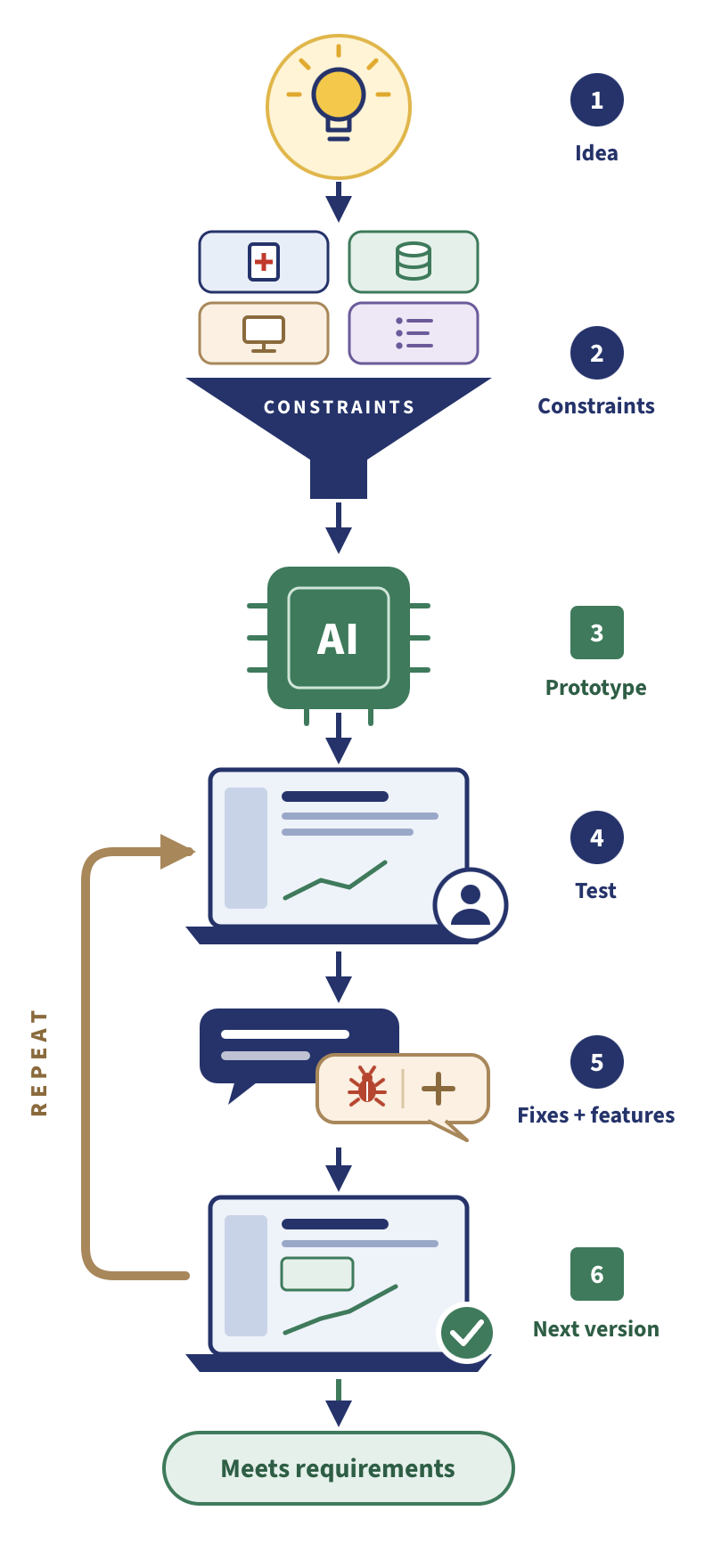
Steps 4–6 repeat until the prototype meets requirements. No programming training needed — zero lines of code authored by hand.
UserAI
Real prompts from the original development session
Building…
Scope — v1.0 Session → v2.0 Today
Features
- 16 clinical domains — MAC, NMB, TIVA, vasopressors, LAST, OB, peds
- 55 drug reference cards — 14 classes, searchable
- 10 bedside clinical tools — RSBI, RASS, Fick, driving pressure
- 100% offline — no data transmitted
- Also: OB/regional protocols · unit conversions · PDF export
Try It — Age-Adjusted MAC
The same age-corrected MAC calculation AnesCalc runs on-device. Nothing you enter leaves this page.
MACage = MAC40 × 10−0.00269 × (age − 40), with MAC40 sevoflurane 1.80%, isoflurane 1.17%, desflurane 6.6%, N₂O 104% (Mapleson WW. Br J Anaesth. 1996;76(2):179-185). Same equation, constants, and minimum floors as AnesCalc’s CalculationEngine.swift. Valid for ages ≥ 1 year. Total MAC sums agent and N₂O fractions. Educational demonstration only — not for clinical decision-making.
Dosing Verification Audit
All values externally reviewed and cross-referenced against UpToDate, Miller's 9e, and Barash 8e.
Beyond This Application
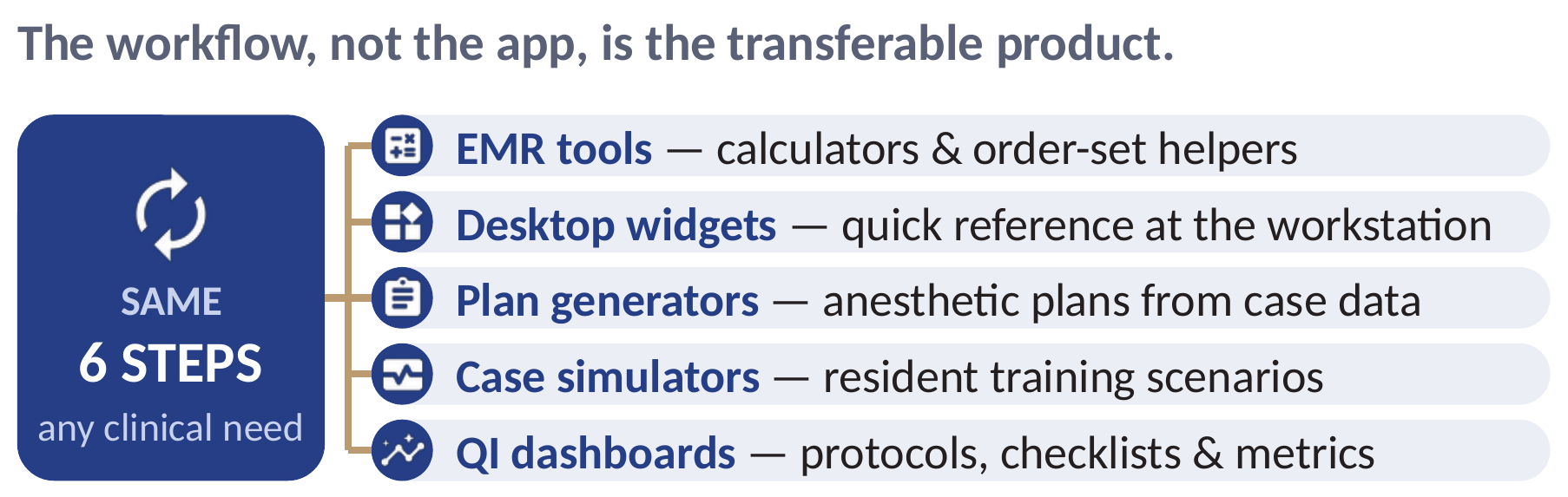
Limitations & Future Work
Limitations
- AI-generated content and calculations require independent verification
- Visual and UI design require iterative human refinement
- Hardware and OS compatibility require testing on physical devices
- Institutional IT, security, and protected health information policies may limit deployment
- Current implementation is iOS-only and has not undergone prospective clinical validation
Future Work
- Prospective outcomes validation
- FDA SaMD regulatory classification
- Clinician evaluation · formal usability review in training contexts
- App Store sponsorship for publication
- Android functionality
AI Disclosure
References
- Gropper MA, Miller RD, Cohen NH, et al., eds. Miller's Anesthesia. 9th ed. Philadelphia, PA: Elsevier; 2020.
- Barash PG, et al., eds. Clinical Anesthesia. 8th ed. Philadelphia, PA: Wolters Kluwer; 2017.
- Eger EI 2nd. Age, minimum alveolar anesthetic concentration, and minimum alveolar anesthetic concentration-awake. Anesth Analg. 2001;93(4):947-953.
- Gan TJ, Diemunsch P, Habib AS, et al. Consensus guidelines for the management of postoperative nausea and vomiting. Anesth Analg. 2014;118(1):85-113.
- Panchal AR, Bartos JA, Cabañas JG, et al. Part 3: Adult Basic and Advanced Life Support: 2020 American Heart Association Guidelines for CPR and Emergency Cardiovascular Care. Circulation. 2020;142(16 Suppl 2):S366-S468.
Materials
Acknowledgments / Contact
The authors thank Emily Waddle, Class of 2029 at Burrell College School of Osteopathic Medicine, NM, for technical data support during the external UpToDate reference validation and algorithmic verification phases.